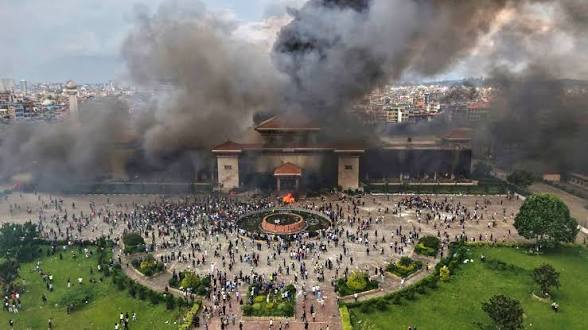
On **8th September 2025**, thousands of young people in Nepal gathered near New Baneshwor, Kathmandu—close to the parliament complex—to protest against corruption and the government’s decision to ban social media. The crowd, mostly between ages **12 to 28**, represented Generation Z: once politically disengaged, now united for change.
The government justified the social media ban by claiming companies had failed to register for regulation. However, citizens saw it as an attempt to silence dissent, since social media had become a powerful tool for exposing corruption. For many youth who used online platforms to promote small businesses and express their voices, this was the breaking point.
The protests grew rapidly—but the government, led by a communist coalition, responded with brutal force. As demonstrators neared the restricted parliament zone, **police opened fire, killing 19 school children**, many still in uniforms. The nation was stunned. Grief turned into fury.
By **9th September**, protests had erupted nationwide, defying curfews. Crowds vandalized and burned the homes of political leaders—current and former prime ministers, ministers, and the wealthy elite tied to corruption. Police stations fell to flames, and chaos consumed the country. With security forces overwhelmed, the **Prime Minister fled** to a Nepal Army barrack. Protesters then torched the **President’s Office, the Supreme Court, Parliament, and Singha Durbar**, Nepal’s iconic 19th-century palace and central administrative complex—reducing them to ashes.
During this chaos, prisons were stormed and **13,000 inmates escaped**, including dangerous criminals and a high-profile politician convicted of fraud. The country was leaderless—no police, no government, only mob rule.
Finally, on **the night of September 9 at 10 PM**, the **Nepal Army** acted independently. Soldiers enforced curfew and regained control nationwide within 24 hours—without firing a single bullet. Order was restored, but Nepal remained shattered.
The Roots of a Violent Culture
This wasn’t sudden. The destruction of 2025 was the result of decades of **impunity**, **elite corruption**, and **romanticization of “revolutionary” vandalism**.
1. 1990: Jana Andolan I — The Birth of Political Vandalism
The 1990 People’s Movement ended the Panchayat system but introduced violence as a political language. Protesters vandalized public monuments and state symbols—acts never investigated but glorified as “revolutionary sacrifices.” This established a precedent: destruction equals victory.
2. 1996–2006: Maoist Insurgency — Institutionalizing Destruction
The Maoist “People’s War” turned sporadic vandalism into a national system of terror. Police stations, bridges, hydro plants, and public offices were bombed. Over **17,000 people died** and billions in property were destroyed. Yet, under the **2006 Comprehensive Peace Accord**, all crimes were politically pardoned. The state rewarded violence with power, teaching citizens that **violence works**.
3. 2006: Jana Andolan II — Democratizing Anarchy
The 2006 uprising again used arson, chaos, and vandalism as instruments of protest. No one was held accountable. Democracy became synonymous with destruction, reinforcing a dangerous idea of “victor’s immunity.”
4. 2015: Tikapur Massacre — Murder and Amnesty
In Kailali’s Tikapur, mobs led by **Resham Chaudhary** killed seven police officers and a two-year-old child. Convicted at all court levels, Chaudhary was later pardoned by **President Ram Chandra Paudel** (Nepali Congress), and celebrated as a political leader. This sent a toxic message: **murder and vandalism can become political credentials**.
The Social Normalization of Violence
- **Student Politics as a Training Ground:**
University student unions—backed by major parties—turned violent politics into a ritual. Arson, clashes, and campus destruction became normal, birthing leaders like **Gagan Thapa** and **Ram Kumari Jhakri**, whose early careers were marked by vandalism.
- **Elite Impunity:**
From deadly road hit-and-runs by ministers to politically protected gang violence, elites face no punishment. Citizens, losing faith in justice, learned to seek “performative justice” through mob retaliation—burning cars, destroying property, torching symbols of power.
The 2025 Climax: An Inheritance of Rage
The **Gen Z protests** were the explosion of this long-accumulated anger. The choice to burn the Parliament, Supreme Court, and Singha Durbar wasn’t random—it was the **final language learned from decades of political vandalism**. Unlike protesters in Sri Lanka or Bangladesh, Nepalis chose complete annihilation of the old order. In less than **eight hours**, the regime collapsed.
Culturalization of Violence
Nepal’s left-leaning intellectuals and media romanticized revolution and vandalism as heroism. Through selective historical memory, Nepal glorified every violent “people’s victory,” erasing accountability. Over time, vandalism became embedded in the **national psyche**—not as crime, but as patriotism.
A Culture Forged in Fire
The burning of Singha Durbar symbolized not only political collapse but cultural decay. It was the **boomerang of impunity**—political parties destroyed by the same fire they once ignited. Unless violence is uncoupled from political legitimacy, Nepal risks remaining in a **cycle of recursive destruction**, where every generation inherits tools of fire, not dialogue.
Conclusion
The vandalism of **September 9, 2025**, was not spontaneous chaos—it was the culmination of 35 years of political impunity. From 1990 to 2025, every protest that glorified destruction planted the seeds of future anarchy.
The fire that consumed **Singha Durbar** burned more than walls—it burned **Nepal’s democratic values, peaceful identity, and cultural heritage**.
Other nations—especially India and South Asia’s young democracies—must learn from this tragedy: **vandalism must never be legitimized as a tool of political transformation**. Once violence becomes culture, civilization itself is in peril.