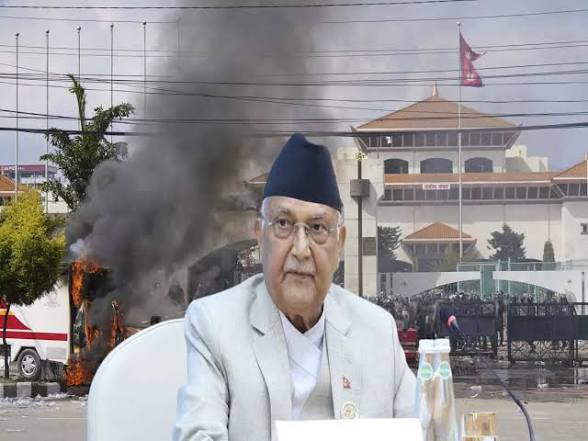
September 8 and 9, 2025, are among the darkest days in Nepal’s modern history. These were the days when the President of Nepal, elected by the Nepali Congress Party, allowed the nation to be reduced to ashes and erased Nepal’s history by burning down the Singh Durbar Complex, the central administrative and historical iconic palace of Nepal.
On September 8, the government brutally crushed the peaceful protests, killing at least 19 school students. This sparked nationwide anger, betrayal, and heartbreak against the joint Communist Government (CPN-UML and Nepali Congress).
The following day, September 9, Kathmandu descended into chaos. The skies filled with smoke as hundreds of public and private properties burned to ash. Iconic historical and administrative buildings, including Singh Durbar, the Parliament building, the President’s office, prime minister’s residence, ministers’ official residences, and the Supreme Court complex, were destroyed in Kathmandu.
Even more shocking to the public was the complete silence, gross failure, and perceived ill intention of President Ram Chandra Poudel. The President was the sole remaining officially elected top authority after security, judicial, and law enforcement agencies failed, and the Communist Prime Minister K.P Sharma Oli had resigned and fled to an unknown army barrack, leaving the nation in flames.
The beginning of the tragedy
On September 8, thousands of young people, mostly from ‘Generation Z’ (born between 1997 and 2012), marched to demand transparency and an end to political corruption.
This peaceful protest was driven by a worsening crisis: national corruption was skyrocketing, hooliganism from political party members was extreme, and the rule of law was collapsing. The media and so-called intellectuals of the country were completely silent about the corruption because they were either beneficiaries or were a part of it. It had become nearly impossible for ordinary citizens to survive in Nepal without political party’s connections.
However, instead of listening to the youth, the government responded with brutal force. Ignoring standard crowd control procedures, the government ordered its forces to open fire as if in war. This killed 19 young school students immediately and severely injured hundreds.
The next day, September 9, the entire country exploded in anger. People poured into the streets, from the smallest villages to the capital city.
Protesters overwhelmed police, burned stations, captured weapons, and attacked homes and businesses of politicians and wealthy elites believed to have unethical political connections. It was the worst internal unrest Nepal had seen in decades.
A nation without a government
In the middle of all this, as the situation went out of control, the communist Prime Minister K.P. Sharma Oli resigned and fled to an army barrack at unknown location. Normally, when a prime minister resigns, the president must assign the same resigned prime minister as the acting prime minister to ensure the government keeps functioning until the next successor is elected by the parliament.
But President Poudel did nothing. He did not assign the resigned K.P. Oli as the acting prime minister. He also did not appoint the role of acting prime minister to another person. Neither did he take the responsibility of the acting government or anything like that. He created a complete power vacuum, leaving the country without a government and without leadership at the most dangerous time.
This was not merely a political failure—it was also an unforgivable constitutional crime committed by President Poudel. His silence, absolute incompetence, and clear ill intent served only to allow the chaos to spiral completely out of control on September 9, a failure that ultimately led to the burning down of the Singh Durbar and its reduction to ashes.
When history burned, the president watched
As flames consumed Singha Durbar—the heart of Nepal’s administration history—the world watched in utter disbelief. The Supreme Court, the President’s own office, and other historic monuments in Kathmandu were under attack by crowds and burning into flames. As the top authority of the country, President Poudel held no any immediate meeting, didn’t order Nepal’s Army to deploy forces and secure these national treasures.
With the Prime Minister already resigned and in hiding, President Poudel was the last constitutional line of defense. Yet, the Commander issued not a single command.
His inaction was an unforgivable betrayal to Nepal and Nepali. Mr. Poudel utterly abandoned the nation, the people, public and private properties. Instead of fulfilling his duty, he was found trembling inside a highly fortified army barrack. Mr. Poudel focused solely on protecting his own life and that of his wife.
No emergency meeting with security forces was called, no national address to calm the public was given, and no state of emergency was declared. Most damningly, no order was issued to the military to protect the nation’s most critical institutions, properties, and historical heart. President Poudel was demonstrably mentally unfit, careless, and a completely selfish figure and historical shame of the country.
If the President claims he was under army custody, this is completely false. Evidence later showed that he was in regular contact with his secretariat and advisors. He was also in touch with leaders of his own party, the Nepali Congress. None of them said he was detained. That means he still had full presidential power — he just didn’t use it. Instead, he let himself be rescued and hidden inside an army barrack, while the capital and the entire country burned and citizens died.
Unconstitutional actions and lies
After days of silence, the President suddenly reappeared — not to mourn the dead or comfort the nation, but to appoint a new prime minister from outside the constitutional system. Constitutional experts called it a direct violation of the constitution. Still, he shamelessly claimed that he had “saved democracy” and “protected the constitution.”
But how can a man who didn’t even order protection for Singha Durbar and Supreme Court — the symbol of Nepali governance and legal system — claim to have saved democracy? How can a leader who refused to act when the nation needed him most now present himself as a hero? He is simply a traitor who should be immediately arrested and jailed for investigation into the damage of properties and the loss of lives on September 8 and 9.
The real truth
President Ram Chandra Poudel failed in every possible way. He failed as the constitutional head of the country. He failed as the commander of the army. He failed as a leader and as a symbol of unity. His silence was not peace — it was betrayal. His inaction was not restraint — it was cowardice. And his later claims of “saving the constitution” are nothing but lies meant to hide his weakness and ill intention.
A lesson for the future
Nepal did not burn only because of angry protesters. It burned because those in power refused to act responsibly. The destruction of Singha Durbar and the loss of young lives will remain as painful reminders of how fragile leadership can destroy a nation overnight.
History will remember September 2025 not as a failure of the people, but as the failure of a president who chose to hide instead of lead.